When you buy through links on our articles, Future and its syndication partners may earn a commission.

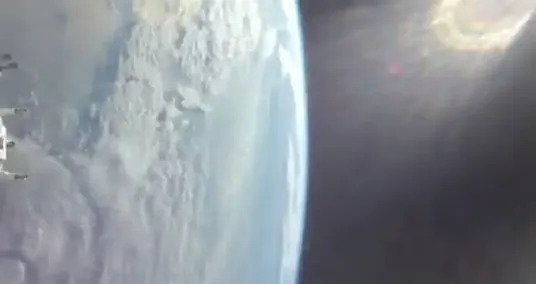
NASA's OSIRIS-APEX spacecraft captured stunning new images of Earth recently as it whipped past the planet during a high-speed slingshot maneuver, sending the probe on a fast track toward the famous asteroid Apophis.
The photos showcase Earth in striking detail during a flyby on Sept. 23 when OSIRIS-APEX — short for "Origins, Spectral Interpretation, Resource Identification and Security-Apophis Explorer" — flew just 2,136 miles (3,438 kilometers) above the planet during its closest approach.
The spacecraft captured swirling clouds over Earth's blue oceans and glimpses of continents passing below. The following day, as it departed Earth, OSIRIS-APEX snapped a dramatic shot of the moon opposite Earth from roughly 370,000 miles (595,000 kilometers), according to a statement from NASA.

OSIRIS-APEX is the second phase of OSIRIS-REx, the mission that returned a sample from the near-asteroid (NEA) Bennu in 2023. After that historic journey, NASA charted a new course toward Apophis, a stony metal-rich NEA that offers a sharp scientific contrast to Bennu's carbon-rich composition (and was once thought to pose a serious impact risk to Earth). The recent images from OSIRIS-APEX mark an early milestone, confirming that its cameras and instruments are fully operational after years in deep space, and that the spacecraft is on course for its interplanetary journey.
The September flyby was designed to use Earth's gravity to boost OSIRIS-APEX's speed and redirect it toward Apophis, which will swing past Earth on April 13, 2029. That encounter will bring the asteroid closer than many satellites — close enough for Earth's tidal forces to potentially reshape the asteroid's surface, alter its spin or even shift its orbit. OSIRIS-APEX is scheduled to arrive shortly thereafter, making it the first mission to document how an asteroid responds to a close planetary pass, according to the University of Arizona's mission overview page.
Once in orbit around Apophis, the spacecraft will spend roughly 18 months mapping the asteroid, studying its composition and capturing high-resolution imagery. Mission planners also hope to hover a few meters above the surface and fire the probe's thrusters downward to stir up dust and reveal fresh previously hidden material.

The newly released Earth images were captured using the spacecraft's MapCam imager, which features red, green and blue filters, as well as StowCam, which is capable of both still and video imagery to verify safe storage of collected asteroid samples.
As the mission continues, OSIRIS-APEX will send back trajectory updates, perform additional instrument checks and eventually deliver the first up-close views of Apophis — a near-Earth asteroid whose close encounter with our planet could teach scientists more about how such bodies evolve and respond to gravitational forces.
LATEST POSTS
- 1
 Soldiers seize power in Guinea-Bissau and detain the president
 - 2EU delegation urges China to tighten export controls
- 3Best Disney Palace: Which One Catches Your Creative mind?
- 4James Webb Space Telescope watches our Milky Way galaxy's monster black hole fire out a flare
- 5AfD faction in western Germany ousts councilman for firebrand speech




- Tech Patterns 2023: 12 Advancements to Keep an eye Out For
- Artemis 2 astronauts head for the moon after make-or-break engine burn (video)
- 7 Powerful Techniques to Boost Efficiency with Your Cell Phone: A Thorough Aide
- Step by step instructions to Guarantee Your Lab Precious stone is Morally Obtained
- Somalia set for 'historic' first offshore oil drilling
- Trump administration launches new immigration crackdowns in New Orleans and Minneapolis. Here are all the cities it has targeted so far.
- The Response to Fake General Knowledge: Investigating the Eventual fate of artificial intelligence
- Reality TV star Spencer Pratt, who lost his home in Palisades Fire, is running for mayor of Los Angeles
- German mid-sized firms gloomy on outlook, survey finds